THE TRAINING TOPICS ARE GUIDED BY THE FOLLOWING CASUISTRY:

BY LOCATION
KEYFIBRE has adequate facilities to teach the classroom courses. It is an equipped room with sufficient capacity for 10-12 students. It is a room with a large central table and a magnificent natural light, with multimedia equipment for the projection of the theoretical contents and blackboards to clearly explain the different concepts. It is equipped with models and panels showing the use of different fiber optic equipment, very useful as practical examples. Its space and large work surfaces make it ideal for all cable stripping or torpedo fusion practices or to work simulating different scenarios and work equipment.
In Company:
All courses can be given at the customer’s facilities. This avoids travel and accommodation costs for those attending the courses or they can even be given at special times so as not to affect the normal development of the activity.
Courses can also be given in training centers by moving the audiovisual media, models, tools and all the elements of the practices.
Likewise, training can be given in classrooms of professional associations or at events or fairs.

BY CONTENT
Many business sectors have fiber optics as their communications infrastructure. Keyfibre provides specialized courses for each of them. These sectors are very different from each other and require knowledge of specific materials and techniques for each of them. The most significant and those that require specific training are:
FTTH
operators, installers, subcontractors, etc.
LOCAL AREA NETWORKS
telecom or IT installers and even electrical installation companies that undertake backbone, backbone or fiber to the desk installations.
EXTERNAL FLOOR
Large operators that need to train their personnel in specific tasks or subcontract them. Companies that are dedicated to a specific part of the whole and want to undertake more work, for example cable companies that want to merge and certify. With the emergence of 5G, there is a considerable demand for specialists.
INDUSTRY
In many industrial installations, fiber optics is the most critical element and, due to its small volume, the most unknown. Automotive plants, water treatment plants, bottling plants, electricity distribution companies, transport and logistics infrastructures, and many others. Special mention should be made of companies dedicated to data processing, Housting & Housing.
COMMUNICATIONS
newspapers, television and radio networks, or press and press advertising agencies.
SECURITY
companies installing intrusion systems, CCTV, access control, etc., since their specificity also requires elements and techniques that are different from the rest.
WIMAX
This is a sector that is deploying communications networks in areas where Ftth networks are not viable and also require special fiber optic links.

BY ATTENDANTS
We provide specific courses for specific professional groups, regardless of whether they belong to the same company or not. The training required by the personnel who deploy the cabling is not the same as that required by those who design, merge or certify it.
Recent graduates or professionals from another field who want to learn a new job have different training needs.
We therefore group course attendees together when their needs are the same or complementary.
We also organize free-to-attend technical conferences at trade fairs or congresses. Depending on the sector that organizes the fair or congress, we adapt the specific content either for dissemination, knowledge expansion or super specific in a particular subject.
We also organize technical conferences for vocational training centers, occupational training centers, universities, business associations…

PER LEVEL
Training courses are designed as a continuous learning tool. It is impossible to train an expert in a first course from scratch.
We always consider the previous level of the student and recommend the specific course for what he/she needs to learn.
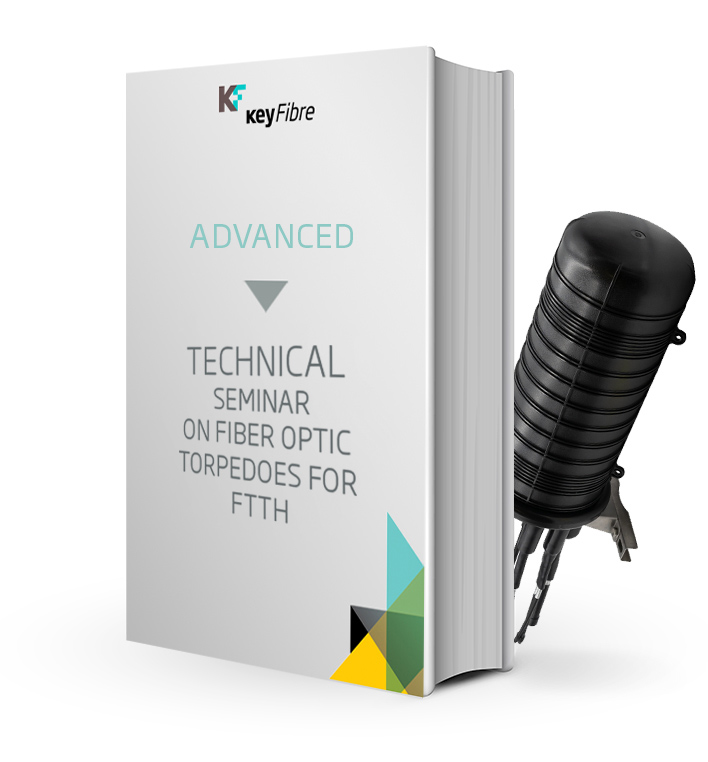
We also teach courses for specific equipment, not commercial presentations but specific courses and specific practices. For example, for a 264-fusion tubular torpedo, for an aerial or microduct laying, for special ribbon or MTO or MTO fibers, for a new fusion splicer or a new OTDR, etc.
Continuous training allows students to learn each step with sufficient immersion to be able to develop their performance autonomously for each level.